Carry More Without Packing Blind
Every pound bolted behind the rear axle acts as a lever on your steering head. Select luggage hardware and pack density around the roads you plan to ride.
Hard Cases vs. Soft Systems: Understanding the Trade-Offs
No single luggage architecture excels on every tour. A rider spending two weeks crossing European motorways and staying in historic town-center hotels faces entirely different priorities than a solo rider linking high-elevation forest roads in Colorado or the Pyrenees.
Hard Aluminum or Molded ABS Panniers (such as GIVI Trekker Outback, SW-Motech Trax ADV, Touratech Zega Pro, or OEM touring cases) excel in urban security and convenience. Top-loading lids let you grab rain gear in ten seconds without unstrapping drybags, and a turn of a key secures cameras or laptops while you step inside a restaurant. Their penalties are static weight, aerodynamic drag, and rigidity: if a rider dabs a foot in a deep gravel rut and the bike tips forward, an unyielding aluminum corner can trap a lower leg unless the rider steps clear immediately.
Rackless and Rack-Mounted Soft Luggage (such as Mosko Moto Reckless 80, Kriega Overlander-S, Giant Loop Siskiyou, or Enduristan Monsoon) sheds 10 to 16 pounds of steel framing and metal box weight. Heavy-duty 1000D Cordura and RF-welded TPU roll-top liners stay completely waterproof even after low-speed tip-overs that might bend a hard case lid out of square. The trade-off is daily discipline: roll-top closures require three full folds to seal out monsoon spray, and leaving the motorcycle unattended in busy tourist ports requires threading a braided steel lock strap (like a Pacsafe or Steelcore cinch) through the bags.
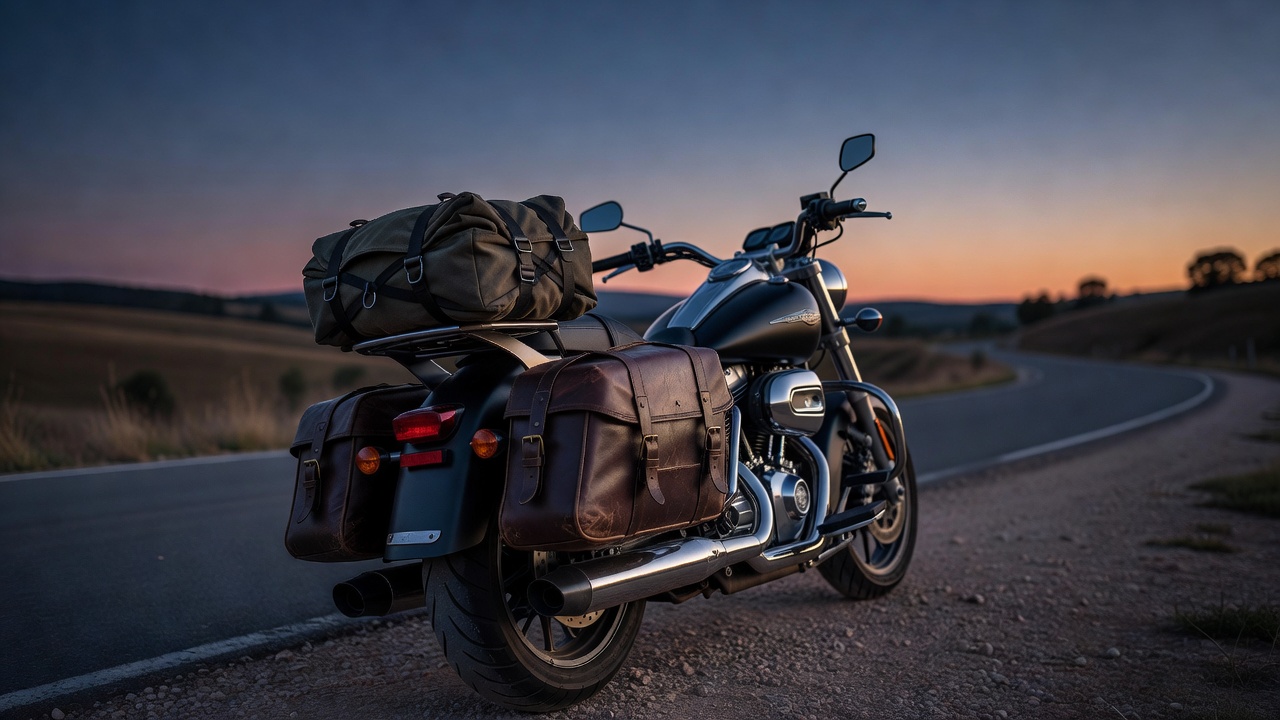
Keeping the heaviest items low in the forward bottom corners of side panniers preserves neutral turn-in response.
Touring Luggage Specification Matrix
| System Type | Typical Capacity | Hardware Dry Weight | Weatherproofing | Best Suited For |
|---|---|---|---|---|
| Aluminum Panniers + Racks | 72L – 89L pair | 22 – 28 lbs (10–13 kg) | Gasket lid (inner dry liners recommended) | Paved two-up touring, multi-stop town sightseeing |
| Molded OEM Side Cases | 56L – 70L pair | 14 – 20 lbs (6.5–9 kg) | Integrated weather seal | Sport-touring bikes, clean aerodynamic integration |
| Rackless Soft Harness | 40L – 80L total | 7 – 11 lbs (3–5 kg) | 100% waterproof removable TPU roll-tops | Rough backroads, lighter middleweight machines |
| Rear Top Box (Aluminum/ABS) | 35L – 58L single | 9 – 14 lbs (4–6.5 kg) | High (rigid gasketed shell) | Locking helmet storage at stops, light bulky layers |
| Quick-Release Tank Ring Bag | 5L – 18L single | 2 – 4 lbs (1–1.8 kg) | Waterproof inner liner or rain hood | Dense electronics, visor cleaner, documents, snacks |
The Golden Triangle of Mass Centralization
Draw an imaginary triangle connecting your motorcycle’s front axle, rear axle, and the top of the fuel tank. Every item packed inside or closely adjacent to this triangle behaves predictably during rapid left-right transitions. Every item mounted high and far behind the rear axle increases polar moment of inertia and unloads the front tire.
- Bottom-Forward Pannier Zones: Pack your densest items—tool roll, tire air compressor, spare chain lube, heavy footwear—at the very bottom and front-most corner of your side panniers, right behind the passenger footpegs. Match left and right pannier weights within 1.5 lbs (0.7 kg) using a handheld luggage scale before departure.
- Tank Bag Priority: Power banks, camera bodies, spare batteries, and lock cables belong in the tank bag where weight rests directly between the steering head and engine cases. Avoid tall, over-expanded tank bags that block your view of the instrument cluster or contact the horn and starter buttons at full steering lock.
- Tail Roll & Top Case Discipline: Restrict tail bags and top boxes to items with high volume and low mass: sleeping bags, down puffers, rain suits, or helmet storage when parked. Check your rear subframe payload sticker—many bikes specify no more than 11 to 22 lbs (5 to 10 kg) on the rear luggage rack itself.
Compartmentalization: The Three-Color Drybag System
Nothing ruins a rainy arrival faster than carrying two mud-splattered aluminum cases up three flights of hotel stairs or rummaging through damp clothing on the roadside to find a thermal liner. Pack inside color-coded lightweight silnylon or TPU inner cubes:
- Crimson Cube (Roadside Rapid Access): Placed at the very top of the right-hand pannier (away from passing traffic on right-hand-drive roads). Contains waterproof shell, winter thermal gloves, neck gaiter, and first-aid kit.
- Slate Cube (Overnight Hotel / Camp Bag): Lifts out with one handle at the end of the day—street shoes, evening clothes, toiletries, and wall charger.
- Ochre Cube (Mechanical & Spares): Stays strapped low in the left pannier for the entire trip—tubeless plug kit, CO2/inflator, zip ties, fuses, and spare clutch/brake lever.